
While the rich have certainly taken an interest in racing, participation in the sport is not confined to blue bloods or multi-millionaires.
If you want to you can own a racehorse. Owning a horse is much more than watching it race for a few brief minutes every now and then. If you invest in the industry and become part of its lifestyle, one thing should be uppermost in your mind - owning a racehorse is a sport, not a business.
Everyone connected with racing is taking part because they love the sport, the horses and the excitement. Part of the challenge in racing is the very fact that money can't guarantee success. There is a long list of expensive racetrack flops and an even longer one of bargain buys - horses bought for a proverbial song who have returned their owners their purchase price many times over.
You don't have to spend hundreds of thousands of dollars to purchase a great horse, there are plenty of stories of exceptional racehorses who were purchased for under $20,000 and have given their owners immeasurable enjoyment as well as considerable financial return.
There is nothing as thrilling as seeing your horse win, be it a Group 1 event in the city or a maiden handicap in the bush.
Queensland horse sales offer pedigrees/bloodlines of International quality, including the most prominent bloodlines from USA, England, Ireland, Japan and France. Queensland horses have outstanding success records across the nation as well as internationally. Export markets including Singapore, Malaysia, Hong Kong, and New Zealand. Australian bloodstock is well regarded throughout the World, with total exports increasing by almost 100% since 1997, with the number of imports decreasing, indicating the popular demand for Australian thoroughbreds Worldwide.
Prizemoney in Australia is a key indicator of the economic health of the industry. In the past six years prizemoney has risen by over 50%, indicating a strong and growing industry. By supporting the Sunshine State you can be in the race for over $16 million prizemoney. Australia is one of the leading nations in distributing prizemoney amongst owners, with the third highest total prizemoney in the world,
If you are new to the industry, don't try to buy a horse without seeking advice. A skilled professional from Magic Millions or other recognised Bloodstock Agent or trainer will provide advice and assistance. They will analyse a sale catalogue for you, bearing in mind your budget and goals. They will then present you with a short list of suitable horses which are expected to fall within your price range, inspect a horse at the sale and arrange for a veterinary inspection of any horse in which you are particularly interested.
Probably a bloodstock agent - or perhaps a trainer - who is well respected in the industry and who has a professional approach to his dealings. For advice and assistance, an agent will probably charge you somewhere around 8% of the eventual purchase price. A trainer will not charge you a fee, but would naturally expect to train any purchase.
An experienced agent will analyse a sale catalogue for you, bearing in mind your budget and your goals. He or she will then present you with a short list of suitable horses which are expected to fall within your price range, inspect a horse at the sale and arrange for a veterinary inspection of any horse in which you are particularly interested. Paying for sound advice is money well spent when it increases your chances of success.
Your thoroughbred is worth insuring. It is important to consult a specialist broker who has a good reputation in equine insurance. For around 4% of its value your horse can be insured for death only. It is not generally possible to acquire insurance for a racehorse against injury or loss of value.
Insurance brokers advertise in thoroughbred publications. The local TBA office can provide a list of specialist companies.
All the glory, but all the cost too.
Race clubs recognise up to a maximum of ten partners racing a horse, each partner appears in the racebook as an owner and is given raceday privileges such as entrance to the members' enclosure and mounting yard.
A syndicate must be registered and a representative appointed. Syndicators must be licensed (the Registrar of Racehorses can supply details). Syndicators buy yearlings at sales and then offer syndicate shares in them through advertisements in the media. You can also form your own syndicate if you choose.
This popular method of racing a horse requires no up-front purchase price. The horse owner, usually the breeder, leases the horse to a partnership or syndicate as above. The terms of a lease may vary, but often the lease is for a period of three years, with no cost to the lessees except that they must pay the lessor one third of all gross prizemoney that the horse may earn.
Horses for lease are infrequently advertised, but your trainer or adviser will probably know of owners willing to lease out a horse. During the term of the lease, the lessees control the racing career of the horse and in the eyes of the racing authorities, are regarded as the owners. At the expiry of the lease, the horse must be returned to the owner.
Buying at auction can be just as exciting as winning a race! You will be duelling with other bidders for the horse of your choice - imagine the thrill when the auctioneer accepts your bid.
More than 5,000 yearlings are sold at auction each year around Australia. The horses are old enough to be assessed by your advisers (vet, trainer, bloodstock agent) for conformation etc, but have not been broken in, so their racing ability has not been exposed.
There are major yearling sales in all capital cities and sales at country venues. The average price at yearling sales around Australia vary from sale to sale, but prices can start at a few hundred dollars or reach as high as $3 million plus.
Champion racehorses can come from humble backgrounds but are more likely to be found at major sales where yearlings are selected on pedigree and conformation and are considered the 'cream of the crop'. There are several major selling agents around Australia and auctions are held in city and country centres. Sales for 'Tried Horses' (horses that have raced) are also held regularly and there are usually yearlings and unraced horses offered at these sales.
Sales companies can supply you with catalogues and information on each of their auctions.
The Federation of Bloodstock Agents Australia has over 30 Members consisting of major sales companies and Bloodstock agents. Contact the Federation of Bloodstock Agents Australia for assistance in locating a bloodstock agent for your needs.
Visit their website at www.bloodstockagents.com.au
Catalogues for major yearling sales are available from the selling agent approximately six weeks before the sale. Catalogues provide extensive details about the relatives of each yearling offered (ie. how many foals / winners the dam has produced, the race and progeny record of a sire).
Catalogues also contain the conditions of sale - the legal terms upon which all purchases are based.
Anyone can attend any sale and seating is unrestricted. It is a public auction and you are free to bid on any lot, as long as you have the finance available. Payment will be required before the horse is removed from the sales complex. You are quite free to ask an attendant to bring a yearling out of its stable for inspection by you, your adviser or your veterinary surgeon.
Once the auction commences, about 25 yearlings will be sold per hour.
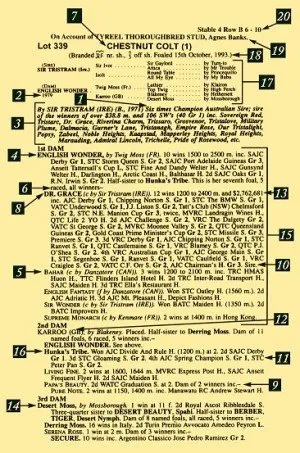
Catalogues for major yearling sales are available from the selling agent approximately six weeks before the sale. Catalogues provide extensive details about the relatives of each yearling offePrizemoney is a key indicator of the economic health of the industry. Since 1987 there has been an increase in prizemoney of some 150%, indicating a strong and growing industry. In the past six years prizemoney has risen by over 50%.red (ie. how many foals / winners the dam has produced, the race and progeny record of a sire).
Australia is one of the leading nations in distributing prizemoney amongst owners, with the third highest total prizemoney in the world, totalling over $421million in 2008/09 at an average of $15,000 per race.
Another reason for buying Australian is that Australian bloodstock is well regarded throughout the world, with approx 1,500 horses being exported last year, with the number of imports decreasing to 950 horses, indicating the popular demand for Australian thoroughbreds worldwide.
The answer is often in one word CHOICE.....
Australia is blessed with Magnificent horse country that is found predominately along the ranges and slopes in Eastern and Southern Australia. Because of it's isolation Australia is relatively free of equine diseases.
The Australian dollar is the most undervalued of all the currencies and this presents great opportunity to overseas buyers. The conversion rate is normally around 52 Australian cents to 1 US dollar mark.
Black type is more conservatively allocated in Australia than in other countries so it really counts. Most countries allocate 5% of their races as group and listed races and often run group with only four or five states.
Black type races are only about 2.5% of total races in Australia and nearly all attract fields of over 10 starters. The criteria and conditions are published and the black type (group and listed races) programme and results can be found on this website under the heading Black Type Racing all results are hyperlink to the Australian stud book for the viewers convenience.
There is only one large herd of broodmares in Australia (Woodlands Stud) and most of the broodmares are in small herds, in fact over 85% of breeders have less than 6 mares.
The smaller and medium sized studs have tremendous success on the track and our analysis of the breeders of Group and Listed races has shown that the bigger studs, which tend to be developing into stallion stations are seldom the breeders of our better horses.
So buyers in Australia have a great choice of rearing skills as well as pedigrees from which to choose.
The national average does not provide an accurate indication as to the cost of owing a racehorse, as cost are considerably higher in metropolitan areas compared to those in country areas. Costs can also vary depending on what state your horse is trained.
For more information on training costs, registration, insurance, spelling, breaking-in, nominations, track fees, please contact Thoroughbred Breeders Queensland Association or people in the industry, and get the facts straight from the horses mouth.
Deciding where your yearling will go to spell after the purchase is an important decision. You need to ensure that it is a reputable spelling complex with well maintained facilities such as, safe fencing so your yearling does not have the chance of hurting itself.
If you have purchased a yearling colt, you may need to find a farm that can accommodate spellers individually. The Stud where you purchased your yearling from may have spelling facilities as well or talk with friends within the industry and ask them if they have any recommendations. The internet is also a great place to search for spelling farms.
Also consider price and feed when enquiring with spelling complexes as they may be the cheapest, but not necessarily the best suited for your yearling (ie. feed only hay and is in a paddock with a large number of other horses). Also remember that you can view the facilities and talk to the Manager to ensure the needs of your valuable livestock is well met.
Once you have made a decision on where you are sending your yearling to spell, you need to organise transport. At the sales complex, there is an area that is specifically set up for transport companies to take bookings. You may have a company in mind already or the spelling farm may have suggested one to you, otherwise there are a number of people at the area that you can speak with. Once your yearling is booked on, the transport company will collect her from her stable at the sales complex and deliver to the spelling farm.
Your valuable yearling is now at a spelling complex and developing into an equine athlete. Although it has been through the sales and been handled, your yearling has not been ridden and therefore, needs to be broken-in. Yearlings can normally be broken in from the age of 15 months (depending on the horse) and this process occurs at a breaking-in facility.
The spelling farm where your yearling is currently may have these facilities; otherwise they may be able to recommend a few for you to enquire about. They can also indicate to you of when your yearling may be ready to brake-in. Education of a young horse is the cornerstone of developing into an athlete, fulfilling its maximum potential, so it is very important that you engage the services of a reputable breaking-in complex.
You can choose a trainer before you purchase your yearling and seek their advice when viewing the yearling. You may select after you purchase and ask for their recommendations on spelling farms and breaking-in facilities or, you can choose your trainer after your yearling is broken-in. In other words, you can choose your trainer at any stage.
You may want to choose a trainer who lives in the same town/city so you can visit your racehorse and watch it during early morning track work, but the options are endless. Trainer’s stables come in all sizes. Some trainers have some stables with only ten (10) horses and on the other extreme a trainer may have a stable of 50 racehorses. Price is also another factor when considering a trainer. Some trainer’s include certain expenses in their daily charges and other trainer’s may charge these expenses on top of the daily rate.
Talk to people in the industry, surf the internet, read racing publications as these are all research tools at your finger tips. Visit this link to view the Australian Racehorse Trainers Directory, a great tool to gain information on trainers or browse trainers in a certain location.
A range of Breeder's and assocations that can provide more information.